Biodiversity Survey - Laman Satong Village
January 2021


Laman Satong Village Forest, located in Ketapang Regency, West Kalimantan, lies between Gunung Palung National Park and the Gunung Tarak Protected Forest (DAS) to the northwest, and two oil palm plantation concessions to the southeast. Situated in a lowland hilly area (at elevations below 100 meters above sea level), the village forest forms part of the Satong and Tolak river catchment area, which flows southward into nearby peat swamp areas and the coast. The village forest encompasses two hills, Bukit Tatas and Bukit Kaderon, separated by the residential settlement of Dusun Manjau, located along a gravel road. Springs within the forest serve as the primary source of flowing water for local residents. Several parts of the forest are considered sacred forest, where religious rituals are performed.
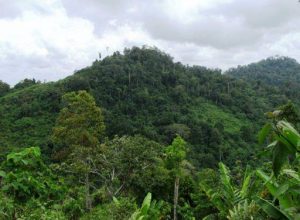
The forest is predominantly composed of secondary forest, agroforestry areas, and shrubland. In the past, forests were logged or cleared for upland rice cultivation. Afterwards, the land was either converted into mixed agroforestry systems (with rubber, fruit, and timber trees) or left fallow for several years before being cleared again for a new cycle of upland rice planting. Currently, under customary regulations, clearing new forest areas is prohibited. Tree planting and/or upland rice cultivation on fallow land (known locally as bawas) is encouraged, but often constrained by a lack of family labor and/or high-quality planting materials. Labor exchange is a common practice to overcome cash and labor shortages.
The mature secondary forests and agroforestry systems are home to a variety of protected Bornean mammals, birds, amphibians, reptiles, and dipterocarp trees. A baseline participatory biodiversity assessment conducted in 2011–2012 recorded 14 mammal species, 158 bird species, 24 species of amphibians and reptiles, and 48 tree species within the project area. Many of these are endemic and listed on the IUCN Red List, including the Endangered Bornean white-bearded gibbon (Hylobates albibarbis) and the Endangered rusty brown dipterocarp tree (Hopea ferruginea).
Additionally, six of the eight hornbill species, often considered indicators of forest health and forest-dwelling specialists were recorded. Other forest-dwelling species observed include the great argus pheasant (Argusianus argus), the Malayan box turtle (Cuora amboinensis), and the Southeast Asian softshell turtle (Amyda cartilaginea).